- Tiruchirappalli | Chennai | Pudukottai | Kumbakonam | Virudhachalam





- Sultan Rice House
- March 4, 2026
- No Comments
By Sultan Rice House
Rice is the heartbeat of Indian cooking. From a steaming bowl of dal-chawal after a long day to the perfectly layered biryani at a family gathering, rice is more than just a grain — it’s comfort, culture, and nourishment all rolled into one. But here’s something most of us never stop to think about: is the rice on your plate actually good quality?
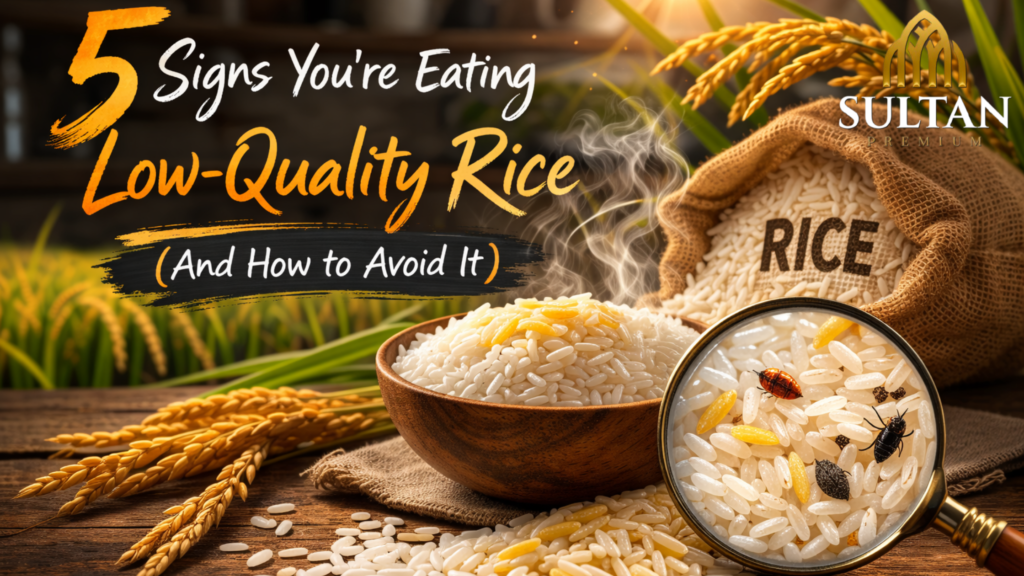
You’d be surprised how many households unknowingly cook with low-grade rice and never realise it. The signs are there — they’re just subtle. Let’s walk through five of the most common ones, and more importantly, what you can do about it.
1. The Water Turns Excessively Cloudy When You Rinse It
Go ahead, rinse a handful of your rice right now. A little milkiness in the water is completely normal — that’s surface starch coming off, and it’s nothing to worry about. But if the water turns thick and white like diluted flour, that’s a different story.
Excessive cloudiness usually means the rice has been over-milled, stripping away its outer layers too aggressively, or worse, that it contains broken grains and rice flour mixed in to bulk it up. Premium quality rice — especially aged basmati — releases very little starch on rinsing. The water clears up quickly, and the grains themselves feel firm and uniform to the touch.
What to do: Hold the rinsed water up to the light. It should look faintly opaque, not milky white. If it doesn’t clear after two or three rinses, you’re working with inferior grain.
2. The Grains Break Apart During Cooking
There’s nothing more disappointing than opening the lid of your rice cooker to find a mushy, clumped mess instead of those long, separate, fluffy grains you were hoping for. If your rice consistently breaks down or sticks together, it’s a strong indicator of poor grain integrity.
High-quality rice — particularly long-grain varieties like aged basmati — is processed and stored in a way that preserves the grain’s natural structure. Broken or immature grains can’t withstand the heat of cooking and collapse into softness. This often happens when rice hasn’t been properly aged or when it’s been stored in poor conditions.
Good rice, when cooked right, holds its shape. Each grain should be distinct, elongated, and slightly firm at the center. If yours is turning into a paste, the rice itself is likely the problem — not your technique.
3. There’s a Stale or Flat Smell
Fresh, quality rice has a subtle, pleasant aroma — nutty, earthy, sometimes faintly sweet. Aged basmati, in particular, has a distinctive fragrance that becomes even more pronounced when it hits the hot water. That smell is a marker of proper aging and storage.
Low-quality rice, on the other hand, smells flat. Sometimes it smells musty or slightly off — a sign that it’s been stored in damp conditions or exposed to humidity. In some cases, rice is artificially polished with chemicals to make it look whiter and fresher than it actually is, and that can produce a faintly chemical or plasticky odor.
What to do: Smell your rice before you cook it. If it doesn’t smell like much of anything or has an unpleasant edge to it, trust your nose. It’s usually right.
4. Inconsistent Grain Size and Color
Pour a small amount of your uncooked rice onto a white plate and take a closer look. What you should see is a collection of grains that are roughly the same length, color, and shape. What you don’t want to see is a mix of long grains, short grains, broken bits, and grains with dark spots or discoloration.
Inconsistency in grain size means the rice hasn’t been properly sorted. It also means your cooking will be uneven — because different-sized grains cook at different rates. What ends up on your plate will be a combination of overcooked mush and undercooked hard bits. Premium rice brands invest in sorting and quality control so every grain you buy is as close to perfect as possible.
5. It Doesn’t Elongate When Cooked
One of the most satisfying things about cooking good basmati rice is watching those grains grow. Quality basmati can nearly double in length when it cooks — that’s the hallmark of proper aging and varietal authenticity.
If your rice looks pretty much the same size after cooking as it did before, it’s either not genuine basmati or it’s been harvested too young and lacks the structural integrity to expand properly. Low-quality rice often shrinks or stays stubby — and it just doesn’t have that satisfying, elegant appearance that makes a plate of biryani or pulao truly special.
So, What’s the Fix?
Honestly, it’s not complicated. You don’t need to become a rice expert or spend hours researching every brand on the shelf. You just need to know where your rice is coming from.
That’s exactly why Sultan Rice House exists.
We started with one simple belief — that every family deserves rice that’s grown right, stored right, and delivered right. At sultanricehouse.in, we don’t just sell rice. We’re particular about it. Every batch is sourced from farmers we know and trust, properly aged to develop that depth of flavour and aroma, and sorted carefully so what reaches your kitchen is genuinely the good stuff.
No fillers. No shortcuts. No rice that smells like it’s been sitting in a warehouse for three years.
If you’ve been settling for whatever’s available at the nearest store, we’d just say — try the difference once. A good grain of rice doesn’t just fill your stomach. It makes the whole meal feel like it was worth the effort.
Come find us at sultanricehouse. Your dal-chawal deserves better. So does your biryani.
Sultan Rice House — Where Every Grain Counts.