- Tiruchirappalli | Chennai | Pudukottai | Kumbakonam | Virudhachalam




- Sultan Rice House
- March 9, 2026
- No Comments
There’s something deeply comforting about walking into a South Indian kitchen in the morning. The air smells of ghee, mustard seeds popping in a hot pan, and something soft and steaming on the stove. If you grew up in Tamil Nadu or spent any time in a traditional South Indian home, you already know that smell. And more often than not, there’s a pot of Nei Kichadi sitting right at the center of it all.
But here’s the thing — the dish is only as good as the rice you use. And if there’s one variety that keeps coming up in every grandmother’s kitchen, every wedding feast, and every everyday meal, it’s Ponni rice.
So why exactly is Nei Kichadi Ponni Rice considered the gold standard for daily South Indian cooking? Let me break it down for you.
What Even Is Nei Kichadi?
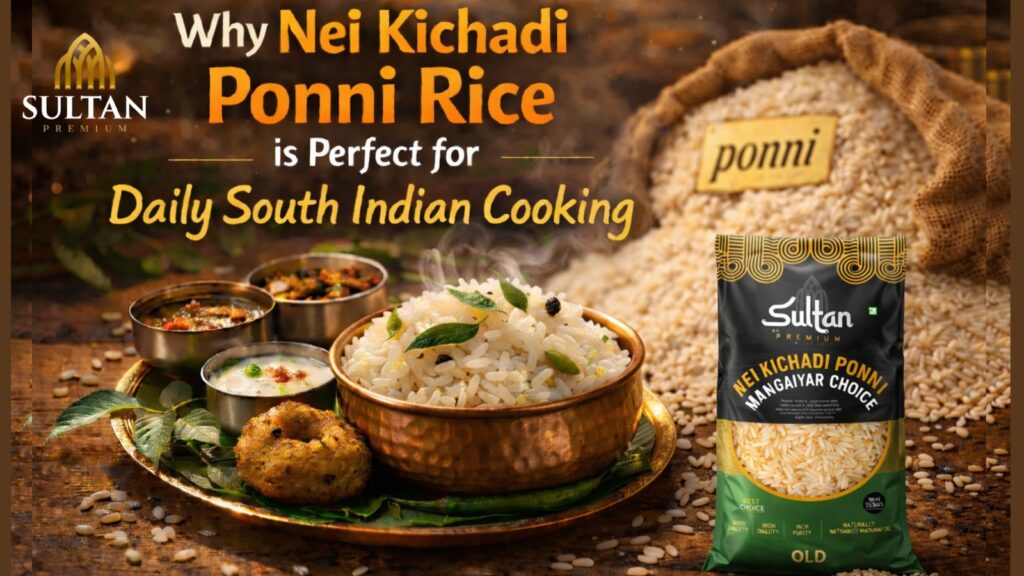
If you didn’t grow up eating it, the name alone might leave you curious. Nei Kichadi, at its most basic, is rice cooked with ghee and a handful of simple spices. That’s it. No complicated technique, no hard-to-find ingredients. Just good rice, real ghee, and a little patience.
The texture is what gets people. It’s soft — properly soft — the kind where the grains have fully relaxed into each other without completely losing themselves. Not watery like a porridge, not firm like plain steamed rice. Somewhere in between, with that unmistakable ghee fragrance running through every bite.
Common Variations of Nei Kichadi
Some households add a small handful of moong dal to thicken it slightly. Others toss in vegetables. But at its heart, Nei Kichadi is a stripped-back dish — the sort of thing that doesn’t need much to be deeply satisfying.
It’s the kind of meal your mother makes when you’re sick. The kind your grandmother insists you eat before a long journey. Light enough to not weigh you down, but filling enough to keep you going through a busy morning.
Why Ponni Rice and Not Any Other Variety?
This is the question most people don’t bother asking — they just reach for whatever rice is in the pantry. But the variety you choose genuinely changes the outcome.
Ponni rice is a medium-grain variety that originated in Tamil Nadu and has been cultivated in the Cauvery delta region for centuries. It’s named after the River Ponni — the local name for the Cauvery — and it carries with it a kind of agricultural heritage that you can almost taste.
What makes it special for Nei Kichadi specifically?
1. It cooks soft without turning mushy
This is the single most important quality for a good kichadi. You want the rice grains to be tender, almost melting, but still hold their shape enough that the dish has some texture. Ponni rice does this beautifully. It absorbs water evenly, swells just the right amount, and doesn’t turn into a gluey mess even if you slightly overcook it.
2. It absorbs ghee and spices like a dream
Ponni rice has a slightly porous grain structure, which means it soaks up the flavors around it. When you add ghee, curry leaves, green chillies, and a touch of ginger — the rice pulls all of that in. Every bite carries the full flavor of the tempering, not just the outer layer.
3. It has a natural, mild aroma
Unlike some high-fragrance varieties that can compete with the other ingredients in the dish, Ponni rice has a subtle, clean smell that complements rather than dominates.
Balanced Flavor Profile
The ghee gets to shine. The spices get to sing. The rice just plays its role quietly and perfectly.
4. It’s gentle on the digestive system
South Indian cooking has always been intertwined with Ayurvedic principles, even if we don’t consciously think about it. Ponni rice is considered easy to digest, which is why it’s given to children, elderly family members, and anyone recovering from illness. For a daily morning dish like Nei Kichadi, that digestibility matters a lot.
The Daily Cooking Angle
Here’s something practical that often gets overlooked in food writing — most of us are cooking on weekdays. We’re not running a food blog photoshoot. We have twenty minutes, a hungry family, and a gas stove that’s been through a lot.
Ponni rice works in your favor here because it cooks faster than aged or parboiled rice varieties. It doesn’t need long soaking times. It’s forgiving — a little extra water or an extra minute on the flame won’t ruin it. That kind of reliability is genuinely valuable when you’re making breakfast before school runs and office hours.
And because it’s widely available across Tamil Nadu and other South Indian states, it’s not an ingredient you need to hunt down. It’s just there, in every shop, at a reasonable price, doing its job every single day.
A Small Note on Ghee
Since we’re talking about Nei Kichadi, it would be a disservice not to mention the ghee.
Choosing the Right Ghee
Use good quality ghee — homemade if you can, or a trusted brand if not. The combination of Ponni rice and real ghee is where the magic actually happens. The rice carries the ghee’s richness without becoming too heavy, and you get that golden, slightly glossy finish that makes this dish look as good as it tastes.
Final Thoughts
Nei Kichadi is not a fancy dish. It doesn’t try to impress anyone. But it shows up every single day — reliable, nourishing, and made with the kind of quiet care that defines South Indian home cooking.
Ponni rice fits that spirit perfectly. It’s not the most glamorous grain on the shelf. But it’s honest, consistent, and genuinely suited for the role. And in a daily kitchen, that’s worth more than anything.
If you haven’t tried making Nei Kichadi with proper Ponni rice yet, now’s a good time to start. Your mornings will thank you.